


Preclinical evaluation of SNH-110: A potent, selective, next-generation RET inhibitor overcoming adaptive drug resistances
American Association for Cancer Research
Shaomei ZengJing WangZanyang YuXuezhen WeiXueyu LiCan YongZhiqiang JiaShuchun ZhaoMin LiLiyang WangNan LiZhiqiang LiYuanqing TangJun Tang
Abstract
Background:
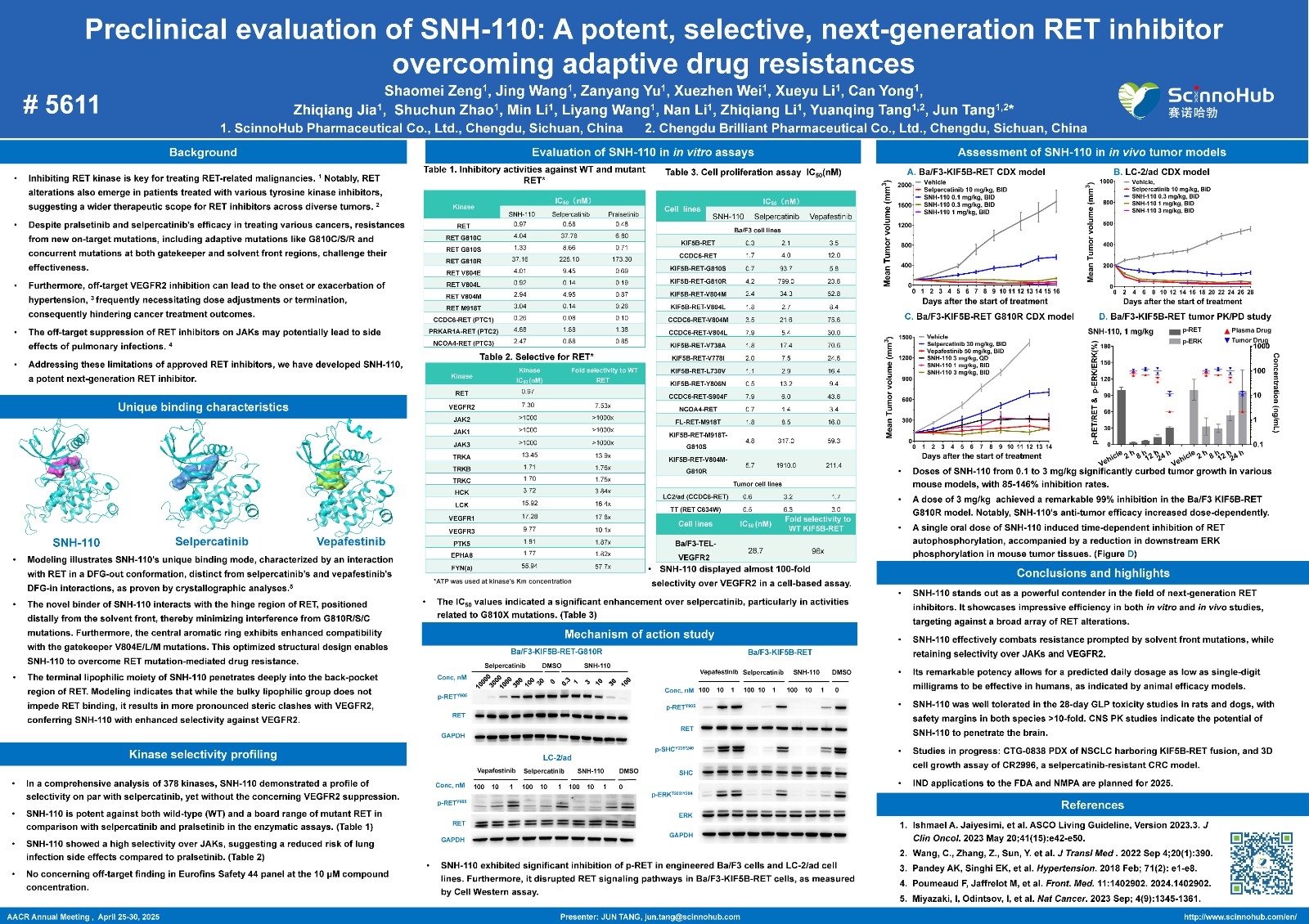
Inhibiting RET kinase is a fundamental therapeutic approach for malignancies related to RET alterations. Despite the remarkable efficacy of pralsetinib and selpercatinib in treating various cancers, resistances due to newly surfacing on-target mutations pose a challenge. The emergence of adaptive mutations at the solvent-front, such as G810C/S/R, coupled with the occurrence of concurrent mutations at both the gatekeeper and solvent front regions, render these medications ineffective. Furthermore, off-target VEGFR2 inhibition can lead to the onset or exacerbation of hypertension, frequently necessitating dose adjustments or termination, consequently hindering cancer treatment outcomes. In response to this urgent challenge, we identified SNH-110, a potent next-generation RET inhibitor.
The selectivity and activity of SNH-110 were assessed via in vitro kinase assays, and its potency was evaluated using modified Ba/F3 cell lines. The in-vivo efficacy of SNH-110 was further validated in a variety of RET-driven tumor models.
In a comprehensive analysis of 378 kinases, SNH-110 demonstrated a level of selectivity on par with selpercatinib, but without the concerning interactions with JAKs and VEGFR2. In cellular proliferation tests, SNH-110 exhibited robust inhibition of a range of Ba/F3 cell lines expressing various RET mutations. The IC50 values indicated a significant enhancement over selpercatinib, particularly in activities related to G810 mutations. Notably, SNH-110 displayed almost 100-fold selectivity against VEGFR2 in a cellular assay, a non-RET target associated with hypertension. At the anticipated effective concentration, SNH-110 showed no inhibitory effects on JAKs, suggesting a reduced risk of lung infection side effects compared to pralsetinib. SNH-110 demonstrated impressive anti-tumor efficacy across various RET-based models. Administered in doses from 0.1 to 3 mg/kg, SNH-110 significantly reduced tumor growth in various murine models, with inhibition rates between 85-146%. In the Ba/F3 KIF5B-RET G810R model, a 3 mg/kg dose of SNH-110 resulted in an exceptional 99% tumor growth inhibition. It's worth highlighting that SNH-110's effectiveness in controlling tumor proliferation increased with the dose across these models.
SNH-110 stands out as a powerful contender in the field of next-generation RET inhibitors. It showcases impressive efficiency in both in vitro and in vivo studies, working against a broad array of RET mutations. Importantly, it effectively combats resistance prompted by solvent front mutations, while retaining selectivity over JAKs and VEGFR2. Its remarkable potency allows for a daily dosage as low as single-digit milligrams to be effective in humans, as indicated by animal efficacy models. A submission of an IND application to the FDA and NMPA is planned for 2025.
 “© 2025 [Scinnohub]. Originally presented at AACR 2025.”